Boyle's Law
Charles' Law
Avogadro's Law
Pressure Unit Conversions
Ideal Gas Law
Kinetic Theory of Gases
Sunday, May 8, 2016

Gas Laws Weekly Quiz
The Gas Laws quiz was not extremely difficult, but it wasn't super easy either. There were a few questions that stumped me because I did not fully understand the Kinetic Theory of energy, and the application questions were kinda hard to understand. The math questions were easy, as you basically had to just plug the numbers into the formula, and the graph questions were easy as well. I think I did okay on the quiz, and I know that I have to prepare a little bit better for the next assessment.
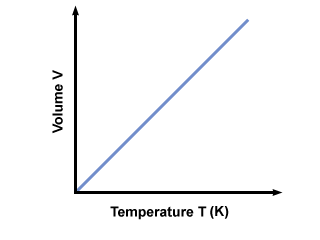
Charles Law
 |
| http://thescienceclassroom.org/chemistry-lessons/gases/the-gas-laws/ |
 |
| http://www.kentchemistry.com/links/GasLaws/charles.htm |
Boyle's Law
 |
| http://thescienceclassroom.org/chemistry-lessons/gases/the-gas-laws/ |
 |
| https://en.wikipedia.org/wiki/Boyle%27s_law |
Thursday, April 28, 2016
Energy and Phase Changes Unit
 |
| http://g.web.umkc.edu/gounevt/Weblec212Silb/L3(12.3-12.4).pdf |
 |
| http://www.kmacgill.com/lecture_notes/lecture_notes_14.htm |
 |
| https://www.boundless.com/physics/textbooks/boundless-physics-textbook/temperature-and-kinetic-theory-12/phase-changes-106/phase-changes-and-energy-conservation-384-6949/ |
The energy and phase changes unit was a fairly simple one. As the unit was only one week long, we ran through the lessons and labs quickly, which was kind of difficult going through all of the information so fast. Although the information was pretty easy, it was difficult to memorize all of the information so fast, but it turned out okay. I prepared a lot for the test the night before, which was good for me, as I got a 95% on the test. Overall, this unit was a success, so I am happy.
 |
| http://www.mrzimmerman.org/New%20Folder/HW/STUDY%20GUIDE%20for%20Prop%20of%20Matter.htm |
Biodiesel Boat Races
 |
| http://www.spokesman.com/stories/2010/jan/02/biodiesel-production-tanks/ |
 |
| http://www.puttputtboats.com/ |
Biodiesel Video
 |
| http://www.alternative-energy-news.info/technology/biofuels/biodiesel-fuel/ |
 |
| http://www.aa1car.com/blog/biodiesel.htm |
Tuesday, April 5, 2016
Pancake Party
For this unit, we decided to have a pancake party to celebrate our success on the test. We brought in all types of toppings, and Mrs. Frankenberg made pancakes for everybody. It was a super chill day and I needed it because I had a bunch of different types of tests and projects due that day, so it was a nice relaxing day in chemistry class.
 |
| http://www.ihop.com/menus/main-menu/pancakes |
.jpg) |
| https://en.wikipedia.org/wiki/Pancake |
Bonding Lecture in the Library
 |
| http://www.unwhiteboard.com/ |
 |
| http://thejohnfox.com/2015/10/what-libraries-shouldnt-be/ |
Wednesday, March 2, 2016
Spec. 20 Lab
 |
| http://biology.clc.uc.edu/fankhauser/labs/microbiology/growth_curve/Spectrophotometer.htm |
Flame Test Lab
To complete the flame test lab, we had to put a variety of different elements over a Bunsen Burner in order to see what color they burned. By knowing what color they burned, we were able to understand the relative wavelength of energy that each element omits when it is heated up. Also, we had to calculate the amount of energy in joules that each element created by looking up the wavelength of the elements. We used the formulas that we learned in class in order to make our calculations, which will help me to study for the test.
 |
| https://www.pinterest.com/pin/324962929341677639/ |
Thursday, February 25, 2016
Third Lecture of Electronic Structure
The third lecture of this unit was easy as well. We learned about quantum numbers and how they are used in the determination of the element. It was easy to understand, as it is very simple and does not contain much hard woork. The quiz over this unit is tomorrow, and I'm feeling pretty good about it. All of the lessons individually were fairly easy, but putting them together may be tough. I need to study a lot tonight in order to ensure that I am prepared for the quiz, but I think I'll be fine.
Subscribe to:
Comments (Atom)