
Tuesday, November 24, 2015
Weekly Quiz for Chemical Reactions Unit
The weekly quiz that we took yesterday was fairly easy. The material contained questions about driving forces, chemical equations, balancing equations, and solubility rules. The quiz was not very difficult, yet it was kinda confusing. It took me a minute to understand what I was being asked, so I had a difficult time processing the quiz at first. Also, there were a couple questions that I was unsure about, so I just had to guess on them. The quiz was only 11 questions, so missing a few will not have a huge effect on my grade.

Solubility Lab


Helpful Links:
List of Solubility Rules
Chemical Reactions Pre Test
Unfortunately, there was no Pre Test for the chemical reactions unit. Usually, the pre tests just make me feel really dumb anyways, so I'm kind of glad that there wasn't a pre test for this unit. Instead of the pre test, we went straight into notes, where we learned about different driving forces of reactions and the parts of writing chemical equations. Also, we learned how to balance normal chemical reactions as well as combustion reactions.
Helpful Links:
Balancing Equations Video
Driving Forces Video
Helpful Links:
Balancing Equations Video
Driving Forces Video
Friday, November 13, 2015
Formula of a Chloride Lab
Yesterday in class, we did the Formula of a Chloride Lab. To complete the lab, we put a small piece of Zinc in a beaker, then added Hydrochloric acid. Next, we put the beaker on a hot plate, and heated the chemicals. The Zinc dissolved into the Hydrochloric acid, then water began to be driven off. We heated the mixture until there was no liquid left, and there was a salt left in the beaker. Then, we cooled the beaker and took it's mass. The purpose of the lab was to determine the empirical formula formula for the salt at the end of the lab. In our results, we got a ratio of one Zinc to 2.068 Chlorine, which was a 3% error, as the real ratio is one Zinc to 2 chlorine atoms.
 |
| https://en.wikipedia.org/wiki/Zinc |
Helpful Link:
Wednesday, November 11, 2015
Formula of a Hydrate Lab
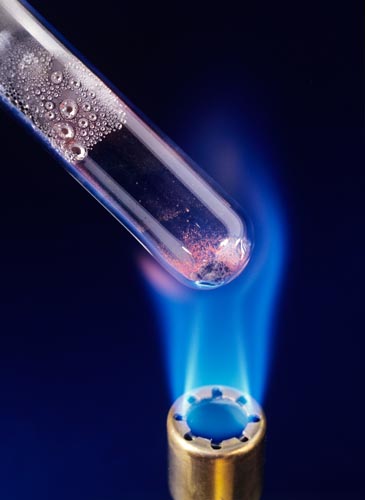
We ran the Formula of a Hydrate Lab on Monday this week, and it was very interesting and connected to our lesson perfectly. We started with Copper (II) Sulfate pentahydride (we didn't figure out that it was pentahydride until completing the lab), and we heated it using a bunsen burner. We heated the chemical in a test tube for about 5-7 minutes, then let the chemical cool before we took it's mass. We took the mass in order to figure out the mass of the water that was driven off, so we could try to find the number of water molecules in the substance. After weighing, we reheated the substance to drive off any additional water, and re-massed to chemical. Then, we calculated the number of water molecules in the substance, and determined that the answer was 5.
 |
| http://www.fphoto.com/?stockindexonline.com=1 |
Helpful Links:
Friday, November 6, 2015
Hydrates
Today in class, we learned about hydrates, which are chemical compounds that have water in them. If the hydrate loses its water molecules, then it becomes an anhydride. The nomenclature for hydrates is simple, for all you have to do is add a prefix for the number of water molecules to the root "-hydride" to the end of the anhydrous chemical. We also learned about using hydrates to solve equations. The equations took a lot of work, but the work was fairly simple and easy to complete. The process is very tedious, though, so a small mistake could lead to a disaster at the end.
Helpful Links:
Hydrates
Hydrate Equations
 |
| http://chemiru.com/products/ammonium-sulfate/ |
Helpful Links:
Hydrates
Hydrate Equations
Monday, November 2, 2015
Chemical Composition Pre Test
The Chemical Composition pre test was extremely hard. I'm not sure that I have ever seen anything on the entire test. The main things I noticed were there were a lot of numbers referring to the masses and percentages of atoms in particular compounds, but I still really had no idea what to do. As I got further and further into the test, I started just guessing, due to the fact that it was extremely hard, as well as it does not factor into my grade. Also, I am excited to learn this new material so that when the post test comes, I'll be able to actually understand what the questions are asking me to do.
 |
| http://sublimestudies.com/welcome/part4-implementation/screen-shot-2012-08-12-at-6-20-46-pm/ |
Helpful Links:
Subscribe to:
Comments (Atom)